Showing posts with label tradition. Show all posts

Wednesday, May 16, 2012

Clapping of Hands in Worship

Is it wrong to clap hands when we worship? Is our worship contradictory to the instructions in Psalms 150?

This is something that has been in my thought since long, especially as we live
in the midst of different Christian groups.

I recently witnessed a glimpse of the worship of the Eritrean (Ethiopian)
Orthodox Church. They use drums,use clapping and even dance while they worship. So obviously these are not forbidden. See here:


But I feel there is a valid reason why our tradition has developed this way. Andit is good. We can always look for change, but we must be careful that our zeal for change does not make us lose something very precious.

Psalms 150 written in the Old testament times gives expression to the ecstatic
and joyous celebration of God. Its an uninhibited release of praise towards the
Almighty Yahweh.

For us Christians though, everything gets colored through the Gospels. King
David did not have the image of the Cross in mind when he wrote Psalms 150. We
read the Old testament seen in the background of Calvary.

We do not see such an unrestrained emotion in the way of worship formed in the
New Testament Church (how could they, considering they were so close to, and
were so well aware of the suffering of the Lord in Calvary), nor in the works of
Fathers of the Church. Mar Ephrem is considered the harp of the Holy Spirit, his
many poems we use in our worship and prayers. In the prayers and Liturgy, we see
an emotion of pain as we identify with the Cross, calmness and silence as we try
to understand the unimaginable love at Calvary. In the New Testament, we see
"psalms, hymns and spiritual songs" but not shouting, clapping and chaos.

This sentiment shines through even in our expressions of joy of Resurrection as
we are continuously reminded to be humble and meek, always alert and ready,not
drunk in celebrations, because the Devil is always round the corner, because our
race is not yet complete.

Since our wise and Holy Fathers sought refuge in this sentiment primarily, our
music and our songs reflect the calmness, the low key and passionate tone as
opposed to the unrestrained expressions of Psalms 150.

We read Psalms 150 in every of our Morning prayers on Sundays, yet we see the
celebrations in the Psalm looking on from the foot of the Cross. Our ecstatic
celebration is given expression in the Holy Eucharist, which the Devil fears,
all other incidents pale in comparison.

This is not because we are moving away from the Bible, this is because we are
truly embracing the music, the song, the message of the Bible, I feel. I don't
think its wrong to clap hands in worship, but I feel it will be a loss if we
don't teach our children why we don't usually do that in worship.

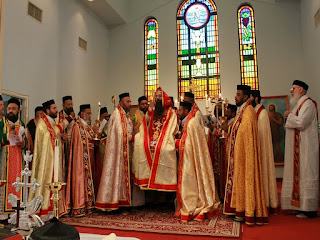
See a section of the Holy Eucharist in Malankara Orthodox/Jacobite Church:

Src: ICON

Glimpse of worship from the 4th Century


Etheria was a woman who travelled the Holy Land sometime in the late 4th century AD. She has written down what she saw as practices of the Early Church then existing in the Holy Land (note that this was before the birth of Islam) - especially during the Holy Week.

(Read about Etheria the Pilgrim on wikipedia or Google. Etheria's maybe the first formal writings by a woman which we have access to.)

As we scroll down to the "Veneration of the Cross" section, we see how the wood of (probably) the original Cross was venerated, bowed down upon, kissed (even bitten away! so guarded by deacons) without anyone doubting if it was idol worship.

Thus the early Church does not seem to have had issues venerating the Holy Cross, these "doubts" that are now gaining popularity among us were probably conveniently planted into our psyche during the time of the advent of Protestantism in the 15th-16th centuries. [Beware of the questions of the serpent who planted the doubt in man by an innocent question.]

(I thank Rev. Fr. Shaji P. John from Nagpur Seminary for pointing us to the work 'Pilgrimage of Egeria' during his classes in Albany, NY during the Holy Week in 2011)

Ref: Pilgrimage of Egeria"(Etheria) 


Src: ICON

An austere Sunthroneeso?

I have a question regarding the Sunthroneeso. I understand it as an act
performed by the Church to raise a bishop to the office of Metropolitan of a
particular diocese. Since we have had several new bishops ordained in the Holy
Church recently, it is but natural that we have several Sunthroneeso ceremonies
in various dioceses.
A Sunthroneeso or Enthronement Ceremony

My question is regarding the cost associated with the ceremony. I heard one diocese spent about 12 lacs (Indian Rupees) for such a ceremony. Also I see it being used by some of our heirarchs as an opportunity for a show of strength, etc. My question - are we missing the point here?

I have no doubt in my mind that the sacrament is important, my concern however is regarding the associated party and spending that seems to be over shadowing the sacrament.

Can something be done about this? Do we take lessons from these for the future?
Will some diocese have the courage and the will to show the way by an "austere"
Sunthroneeso?

Src: ICON

Hoosoyo for Babies

Absolution from sins
The last time I saw a priest laying hands on a baby and giving the traditional "Hoosoyo" (It is a silent prayer by the priest touching the forehead of the faithful), prompted me to write this. What is the achen praying while laying hands on the baby?

In the case of an adult, I do understand he is praying for the forgiveness of the sins committed by the adult, and using the authority bestowed on him by Christ to forgive his sins. Also, I understand Hoosoyo to be a convenience vehicle in place of the Holy Confession.

But in the case of the baby, what sins are being forgiven? The baby who has not even begun to walk or talk - is he\she capable of sinning or being maligned by the sins of this world? In my mind, the Hoosoyo seems rather surreal in the case of a baby.

Will it make sense for the baby to be spared of the Hoosoyo and be given Holy  Qurbana directly? Or is it a separate prayer being prayed for babies (or for children who are not old enough to confess)?

Have we given enough thought on this? Are we just having the ritual of Hoosoyo for the baby out of habit or to just to conform to the popular sequence in our minds?

Wanted to know what others think about this.

Src: ICON

Great Lent 2020 - 50 Days in 50 Messages

2020 - A Unique year. I had the opportunity to prepare and present my thoughts through the 50 days of the Great Lent of this remarkable year...